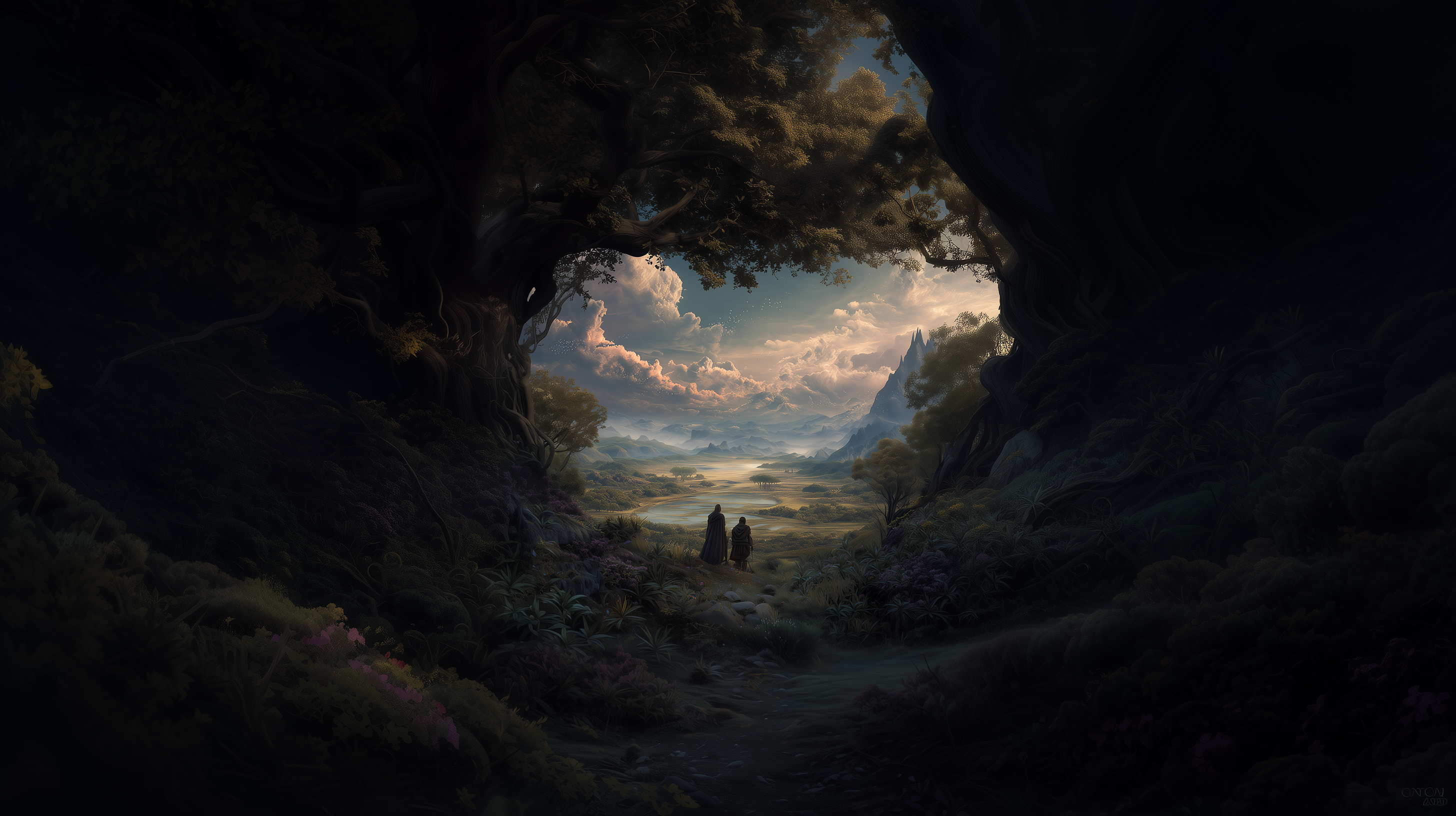

“The value of the myth is that it is the one thing which relates truth to actual experience.” — C.S. Lewis
Introduction: The Pulpit and the Pen
As the Lead Pastor of Silver Creek Fellowship, I spend much of my life dealing in the currency of truth—exegesis, doctrine, and the care of souls. But as the author of The Whispers of Eden, I also inhabit a world of giants, ancient evils, and prophetic lines of redemption.
To some, these two vocations—Pastor and Fantasy Author—might seem contradictory. One deals with reality, the other with “make-believe.” But I am writing this to you, my fellow laborers in the field of Christian fiction, to tell you that this is a false dichotomy.
We are not merely entertainers. We are standing at the “side door” of a skeptical culture. Where the front door of the church is often bolted shut by cynicism or past hurt, the door of the imagination remains wide open. It is our job, and our joy, to walk through it.
Our Heritage: The Night on Addison’s Walk
We are not the first to walk this path, nor do we walk it alone. The theological bedrock of our craft was laid late on the windy night of September 19, 1931, along a path known as Addison’s Walk in Oxford.
Three men strolled under the trees that evening: C.S. Lewis, J.R.R. Tolkien, and Hugo Dyson. At the time, Lewis was a theist but not a Christian. He was torn by a painful internal division: his intellect demanded cold, hard facts, yet his heart starved for the wonder found in pagan myths—stories of dying gods like Balder and Adonis. He tragically concluded that these myths were merely “lies breathed through silver”—beautiful, but ultimately hollow.
It was Tolkien who dismantled this despair. He argued that because we are made in the image of the Creator, we are “sub-creators.” When we weave a story, we are not necessarily fabricating lies; we are often discovering “splintered fragments of the true light.”
Tolkien then delivered the stroke that would change Lewis’s life—and our literature—forever. He proposed that the story of Jesus Christ is the “True Myth.” It possesses every quality of the great fairy tales we crave—the eucatastrophe (the sudden joyous turn), the hero’s descent into darkness, the defeat of death—but with one earth-shattering difference: It entered history. The Gospel is not a story that floats in the ether; it is the moment the Poet stepped inside His own poem. This realization healed the rift in Lewis’s soul. It validated the imagination not as an escape from reality, but as a uniquely powerful lens for seeing the Ultimate Reality.
Walking in the Footsteps of Giants
When we sit down to write, whether it’s a fantasy epic or a contemporary drama, we stand on the shoulders of those who used fiction to preach what a sermon sometimes could not.
- John Bunyan: Writing from a jail cell, he turned abstract theology into The Pilgrim’s Progress. He knew that the Christian life is a narrative arc, and he gave the church a map for the spiritual journey that even a child could read.
- George MacDonald: The “Grandfather of the Inklings” and a Scottish minister who understood that the imagination is the chamber where man meets God. He taught us that stories can baptize the imagination long before the intellect accepts the creed.
- Dorothy L. Sayers: She used detective fiction to show that the overarching story of the Gospel is the most exciting drama ever told.
The Master’s Mandate: Why We Must Tell Stories
However, the ultimate permission slip for my work on The Whispers of Eden, and for your work as well, comes from Jesus Himself.
In Matthew 13, when asked why He spoke in parables, Jesus revealed that stories have a dual power: they reveal the mysteries of the kingdom to the hungry, while concealing them from the proud. Jesus did not simply lecture on “The Abstract Principles of Divine Mercy.” He told us a story about a Prodigal Son. He did not give a seminar on “Neighborly Ethics.” He introduced us to a Good Samaritan.
As Christian authors, we follow the Master’s method in three ways:
- We Subvert Defenses: Just as Nathan the prophet disarmed King David with a story about a sheep before revealing his sin, our stories can slip past the “watchful dragons” of a secular reader’s defenses.
- We Incarnate Truth: Jesus is God in flesh; a story is Truth in “flesh.” We give abstract theological concepts a body, a face, and a struggle, allowing readers to feel the truth.
- We Build Memory: People may forget my three-point sermon by Tuesday, but they will remember the narrative of the Sower for a lifetime. We survive on stories.
A Charge to Christian Authors
Friends, we live in a biblically illiterate but story-hungry world. If we vacate this space, we leave the discipling of the world’s imagination to the secularist.
So, I charge you:
- Do not sanitize the struggle. Do not write safe stories. The Gospel is not safe; it is good. Our fiction must be dangerous to the darkness, not afraid of it.
- Offer the “True Myth” Hope. In a market saturated with dystopia and nihilism, let your writing offer the hope that the shadow is only a small and passing thing.
- Point to the Source. My goal with The Whispers of Eden is to create a world that makes the reader homesick for a place they have never been—a longing that can only be satisfied by Christ. I pray the same for your books.
We are tilling the soil of the heart so that the seed of the Gospel might find a place to root. Let us write with excellence, with courage, and with the knowledge that we are following the path of the True Myth.
Kurt Barnes Lead Pastor, Silver Creek Fellowship Author, The Whispers of Eden

Leave a Reply