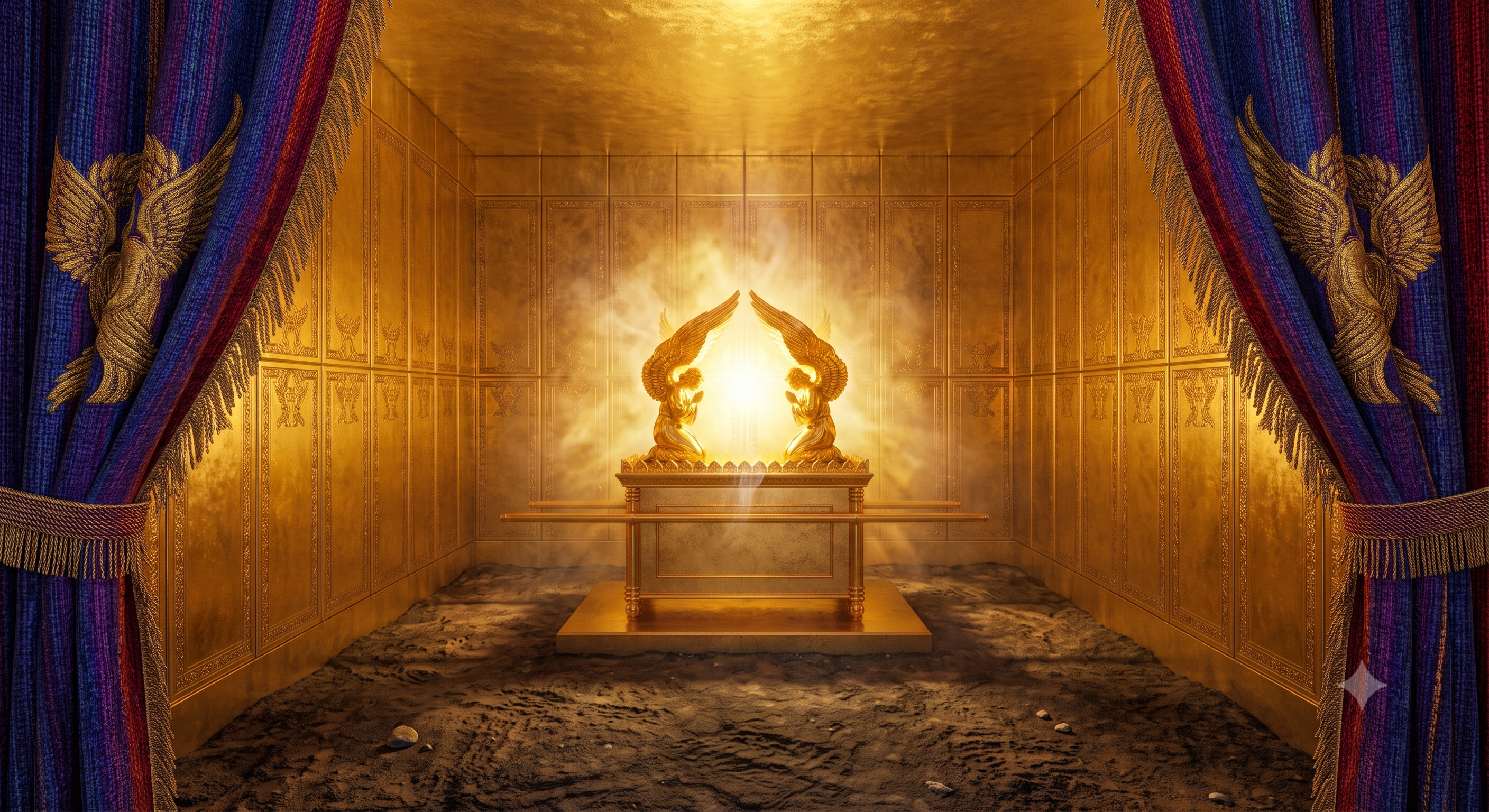
There is a moment, stepping from the noise and chaos of ordinary life into a quiet place of worship, when something shifts. The clamor fades. The air changes. And something deep in the human soul recognizes that it has arrived somewhere it was always meant to be. That experience is not accidental. It is ancient. And it is written into the very architecture of the Tabernacle — the dwelling place God designed for His people in the wilderness.
The Tabernacle was not merely a tent. It was a theological roadmap. Every piece of furniture, every material, every measurement was a declaration about who God is and how He has made a way for broken people to draw near to Him. Walking through its rooms is not an exercise in religious history. It is a journey into the heart of the Gospel itself.
A Table in the House of God
The first piece of furniture inside the Holy Place was the Table of Showbread. Twelve loaves of bread, arranged in two stacks of six, rested on a gold-covered table on the north side of the room. Twelve loaves for twelve tribes. Every family. Every name. Every generation represented before God.
Here is what stops you in your tracks: the first thing God placed inside His house was not a weapon, not a throne of intimidation, not a ledger of offenses. It was a table. With bread on it.
This matters enormously. In the pagan religions surrounding Israel, people brought food to their gods because they believed the gods needed to be fed and sustained by human hands. But the God of Israel operates on entirely different terms. Psalm 50:12 makes it plain that if God were hungry, He would not need to tell anyone, because the world and everything in it belongs to Him. He does not need bread from human hands. He is the source of every loaf that has ever existed.
The Table of Showbread was not a reminder that God depends on His people. It was a declaration that His people depend on Him. He does not come to the table hungry. He comes as the Host.
And that table points directly to Jesus, who stood before a crowd in John 6 and declared that He is the bread of life — that whoever comes to Him will never go hungry. He was born in Bethlehem, which in Hebrew means “House of Bread,” and He was laid in a manger, a feeding trough, because He had come to feed the starving souls of humanity. When He fed five thousand people in the wilderness, the disciples gathered exactly twelve baskets of leftovers. Not an accidental number. A declaration: there is enough. There has always been enough. He is enough.
Light That Makes Everything Else Visible
Directly across the room from the Table of Showbread stood the Golden Lampstand — the Menorah. There were no windows in the Holy Place. No natural light. Without the Menorah, the priest could not see the table, could not see the incense altar, could not navigate the room at all. The lampstand did not merely add ambiance. It made everything else visible.
It was crafted from a single talent of pure gold—approximately 75 pounds—hammered from one continuous piece. No seams. No separate parts joined together. And it burned continuously, fueled by pure, pressed olive oil.
Jesus stood in the Temple during the Feast of Tabernacles, where giant golden menorahs blazed as part of the festival, and declared in John 8:12 that He is the light of the world, and that whoever follows Him will never walk in darkness. He is the true Lampstand. He makes God visible. He guides the steps of those who follow Him.
And the fuel? Crushed olives. On the night before His crucifixion, Jesus went to a garden called Gethsemane—which in Hebrew means “The Olive Press.” There, at the foot of the Mount of Olives, He was crushed under the weight of the sin of the world. Luke records that His sweat became like drops of blood falling to the ground. Through that crushing, the oil of the Spirit would be poured out on His people. And then Jesus turns to His Church and says in Matthew 5:14 that they are the light of the world. His light, shining through His people.
The Prayers That Rise Like Incense
At the far end of the Holy Place, positioned directly in front of the veil guarding the Holy of Holies, stood the Altar of Incense. Morning and evening, the priest burned a sacred, specially formulated blend of spices on this golden altar. The smoke rose, drifted over the veil, and saturated the very throne room of God.
Psalm 141:2 captures it perfectly, expressing the desire for prayer to rise before God like incense, and for lifted hands to be like the evening sacrifice. In Revelation 5:8, the golden bowls held before the Lamb are identified explicitly as the prayers of God’s people.
And where is Jesus right now? Hebrews 7:25 reveals that He lives to intercede for those who come to God through Him. He is at the right hand of the Father, at the true Golden Altar of heaven, carrying the prayers of His people before God continuously.
The Veil That Was Torn
Beyond all of this stood the Holy of Holies, separated from the rest by a thick, heavy veil embroidered with cherubim—a deliberate echo of Eden, where cherubim with a flaming sword guarded the way back to the presence of God after the Fall. Only the High Priest could enter, only once a year, only with the blood of a spotless sacrifice.
Then Jesus died on a Friday afternoon outside Jerusalem. And at the exact moment of His death, Matthew 27:51 records that the curtain of the Temple was torn in two from top to bottom. Not from the bottom up, as a man might tear it. From the top down. God tore it.
The way back into His presence was opened.
Hebrews 10:19-20 explains that because of the blood of Jesus, we now have confidence to enter the Most Holy Place by a new and living way opened through the curtain—through His body.
You Have Access
You do not drift into intimacy with God. Nobody accidentally builds a life rooted in His presence. But the invitation is real, and the access is complete. You are not approaching God to convince Him to accept you. In Christ, you are already accepted. You are not hoping He will tolerate you if you perform well enough. Because of Jesus, you come as a son. You come as a daughter. Washed, forgiven, clothed in righteousness, and welcomed.
The table is set. The light is on. The prayers are rising. The veil is torn. The Father is not standing at the gate with crossed arms. He is standing there with open arms.
Draw near. And do not just visit. Learn to live there.

Leave a Reply