Most people assume the climax of the Exodus story is the parting of the Red Sea. Hollywood certainly does. We picture Moses raising his staff, walls of water rising on either side, and a nation of freed slaves walking through on dry ground — and we think, “That’s it. That’s the moment.” But that reading misses the entire point of the book.
The Red Sea was not the destination. It was the doorway.
God did not rescue Israel merely to get them out of Egypt. He rescued Israel to get Himself into their midst. The whole forty-chapter arc of Exodus is building toward a single, stunning reality: a holy God choosing to dwell among an unholy people. And when you understand that, everything changes — including how you understand your own story.
It Began in the Mud
Exodus does not begin in a glorious sanctuary. It begins in the suffocating mud pits of Egypt, where a nation of people are nameless, broken, and crushed under the weight of generational slavery. They are weeping over murdered children. They are drowning in despair. And from the outside, it looks like God has forgotten them entirely.
But He had not. Exodus 2:24-25 tells us that God heard their groaning, remembered His covenant, saw their suffering, and knew. He was not absent. He was not indifferent. He was not late. Beneath the surface of their pain, the faithfulness of God was already moving.
Between Exodus 1 and Exodus 40, God unleashes the most extraordinary rescue operation the world had ever seen. Ten plagues dismantle the greatest empire on earth. The Red Sea splits. Bread falls from the sky. Water flows from a rock. A covenant is made at Sinai. And through it all, the question the book is quietly answering is not simply, “Will God free His people?” but rather, “Where is God taking them, and why?”
God answers that question plainly in Exodus 25:8, where He instructs Moses to build a sanctuary so that He may dwell in the midst of His people. And again in Exodus 29:45-46, He says that He brought them out of Egypt specifically so that He might dwell among them. Deliverance was the doorway. Dwelling was the destination.
A People Transformed by Grace
By the time you reach Exodus 39 and 40, something remarkable has happened to these people. A phrase begins repeating like a drumbeat through the final chapters: “just as the Lord had commanded Moses.” It appears eighteen times across those two chapters. Every curtain hung, every pole inserted, every garment finished — all of it done in precise obedience to God’s instructions.
If you have been paying attention to Israel throughout the previous thirty-nine chapters, those words are nothing short of miraculous. These are the same people who panicked at the Red Sea and accused God of dragging them into the desert to die. The same people who grumbled about water, complained about food, hoarded manna, and ultimately melted down their gold jewelry to worship a calf while Moses was on the mountain receiving God’s law.
What changed? Their hearts were transformed by grace. They had witnessed God forgive their worst rebellion and still choose to dwell among them. And that kind of grace does not produce lawlessness — it produces worshipers. As Paul writes in Titus 2:11-12, the grace of God brings salvation and trains people to renounce ungodliness and live upright lives.
Legalism says, “Obey so God will love you.” Grace says, “Because God has loved you, your heart is now free to obey.” One is Pharaoh’s worksite. The other is the Father’s house. The God of Exodus did not redeem slaves from Egypt so He could become a better Pharaoh. He redeemed them to make them His treasured possession.
The King Moves into the Neighborhood
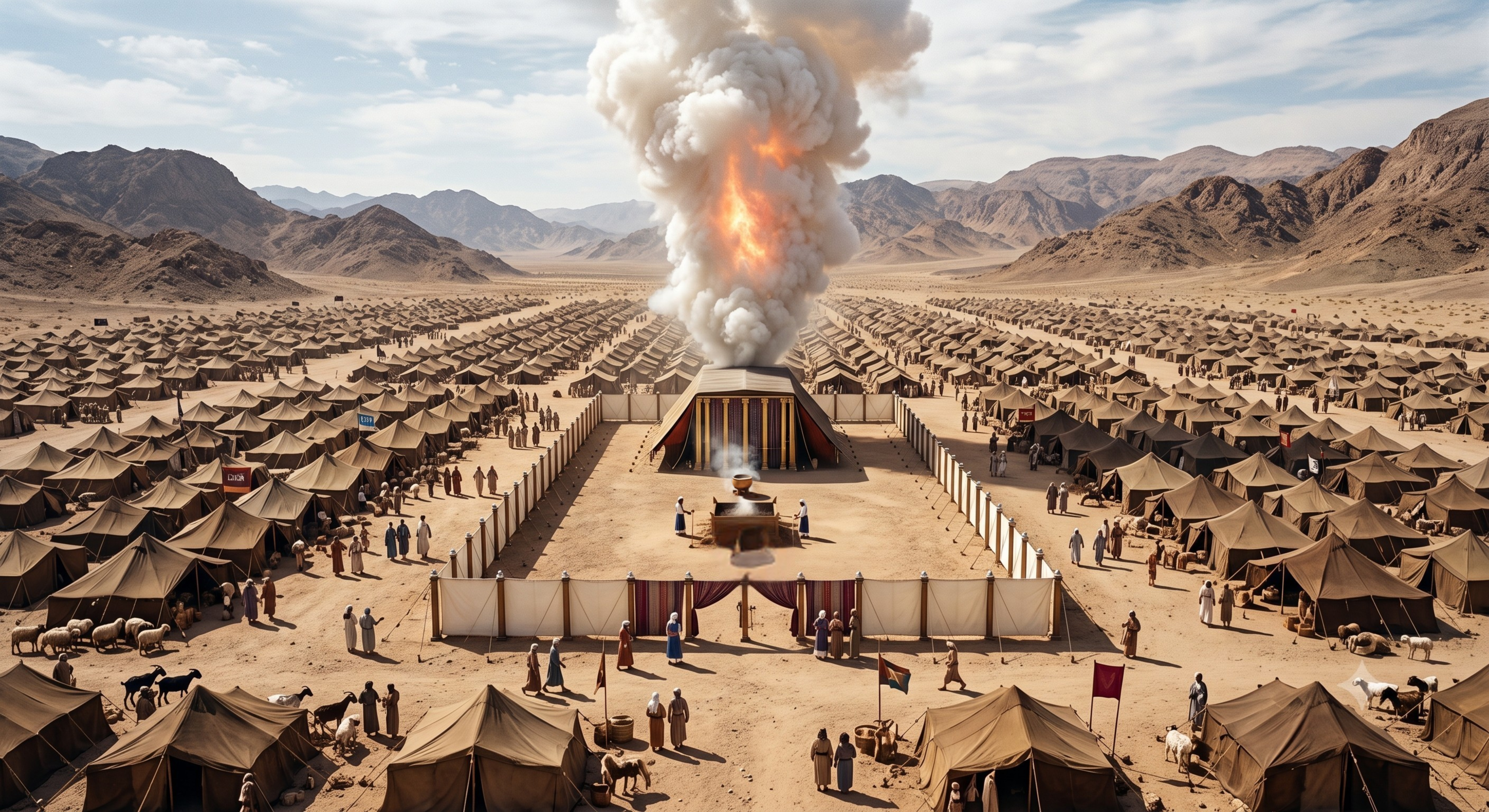
When the Tabernacle is finally completed and set up in Exodus 40, notice where it is placed. Not on an inaccessible mountain peak. Not miles outside the perimeter of the camp. It is placed in the dead center of Israel’s life. Three tribes to the north, three to the south, three to the east, three to the west. The Tabernacle in the middle. Every morning when the people opened the flap of their tents, the first thing they saw was the cloud of God’s presence hovering over the sanctuary.
The holy God of heaven had moved into the neighborhood.
Then, in verse 34, the glory of the Lord fills the Tabernacle. It is the moment the entire book has been building toward. But verse 35 delivers a jarring twist: Moses cannot enter. Moses — the man who spoke with God face to face, whose face shone with reflected glory, who spent forty days on the mountain in God’s presence — is standing outside, unable to go in.
The house is built. The King has arrived. The glory has filled the room. But the front door is barred shut. And the question Exodus leaves us with is not whether God will dwell with His people. He already has. The deeper question is: how can sinners survive the nearness of a holy God?
The Answer the Whole Bible Has Been Building Toward
That question is why the sacrificial system exists. That question is why the altar burned morning and evening. That question is why a high priest entered the Holy of Holies once a year with blood. Every sacrifice was God’s gracious provision — a way for His holiness to dwell among His people without consuming them.
But those sacrifices could only cover temporarily. They could not deal with the root of the problem once and for all. So the altar kept burning. Lamb after lamb. Year after year. Generation after generation. Until the Apostle John opened his Gospel and wrote in John 1:14 that the Word became flesh and tabernacled among us — full of grace and truth.
Jesus is the true and better Tabernacle. He is the place where God and humanity meet. His blood does not merely cover sin — it removes it. His flesh, torn at the cross, is the veil that was opened so the way into God’s presence would never be barred again. When He cried “It is finished,” the temple veil tore from top to bottom. God opened the way.
Now, because of Christ, Hebrews 10:19-22 extends an invitation that would have been unthinkable in Exodus 40: draw near with confidence, with hearts sprinkled clean, through the blood of Jesus. Not because you have been impressive. Not because your obedience has been flawless. But because Jesus has opened the way.
The Dwelling Place Has Changed
Here is where the story becomes even more astonishing. The dwelling place of God is no longer a tent made of animal skins and acacia wood. By the Holy Spirit, the dwelling place of God is now His people. First Corinthians 3:16 asks the question directly: do you not know that you are God’s temple and that God’s Spirit dwells in you?
God is not merely building a room for His people. God is building His people into a room for His presence.
The story of Exodus began in slavery. It ends in glory. It began with Pharaoh saying, “Get back to work.” It ends with God saying, “I have come to dwell among you.” And the gospel announces something even greater still: the God who moved into the Tabernacle has now moved into His people.
So draw near. Draw near when you feel weak. Draw near when shame is loud. Draw near when you have been distant for far too long. The command is not “clean yourself up and then come near.” The invitation is “come near, because Christ has already made you clean.”
The veil has been torn. The blood has been shed. The door is open. The King has come near.

Leave a Reply